 Italiano
 Deutsch
- 6 min read
- Guide

Among top surgery techniques there is no single best option: the right choice depends on your chest and your goals. This guide explains the key criteria and the questions to ask your surgeon.
Top surgery techniques: why there is no "best" option for everyone
Which of the top surgery techniques is right for you? Double incision suits medium to large chests or less elastic skin, periareolar suits small to moderate volumes with elastic skin, keyhole only very small chests, and buttonhole is used when the nipple should stay on a pedicle. Your surgeon makes the final call after an examination.
Anyone researching top surgery – chest masculinization or subcutaneous mastectomy for trans men, transmasculine and non-binary people – quickly comes across many names: double incision, periareolar, keyhole, buttonhole, inverted T. Each technique solves a specific problem: removing glandular tissue, removing excess skin and, where needed, resizing and repositioning the areola and nipple. Which combination fits depends first of all on the anatomy of your chest, not on abstract preferences.
The final decision is always made together with the plastic surgeon after a physical examination. Knowing the criteria in advance, however, helps you arrive at the consultation with realistic expectations and the right questions. Each procedure is described in detail in our overview of all top surgery procedures.

The main criteria
Chest size
The more tissue is removed, the more "empty" skin remains afterwards. With a small volume the skin can often adapt to the new contour on its own; with a medium or large volume, excess skin usually has to be removed through longer incisions.
Skin elasticity
Firm, young skin tends to retract well; less elastic skin – with stretch marks or after major weight changes – retracts less. Long-term binding may affect skin quality; we cover this in our guide to binding before top surgery.
Nipple position and size
If the nipple-areola complex already sits in a position that suits a masculine chest, it can stay attached to its tissue pedicle. If it is low or large, it is often reduced and repositioned – with free nipple grafts (double incision) or on a pedicle (buttonhole / inverted T).
Sensation as a priority
Techniques that keep the nipple attached to the underlying tissue (periareolar, keyhole, buttonhole) may offer a better chance of preserving some sensation, although this is never guaranteed. With free grafts, nipple sensation is usually reduced and may only partly return over months or years.
Scars
Shorter incisions mean less visible scarring, but not always a better contour: excess skin left behind can cause folds or irregularities that need revision. A longer but well-placed scar along the lower edge of the pectoral muscle often gives a flatter, more predictable result.
Technique comparison table
| Technique | Typical chest (approx.) | Scars | Nipple | Points to consider |
|---|---|---|---|---|
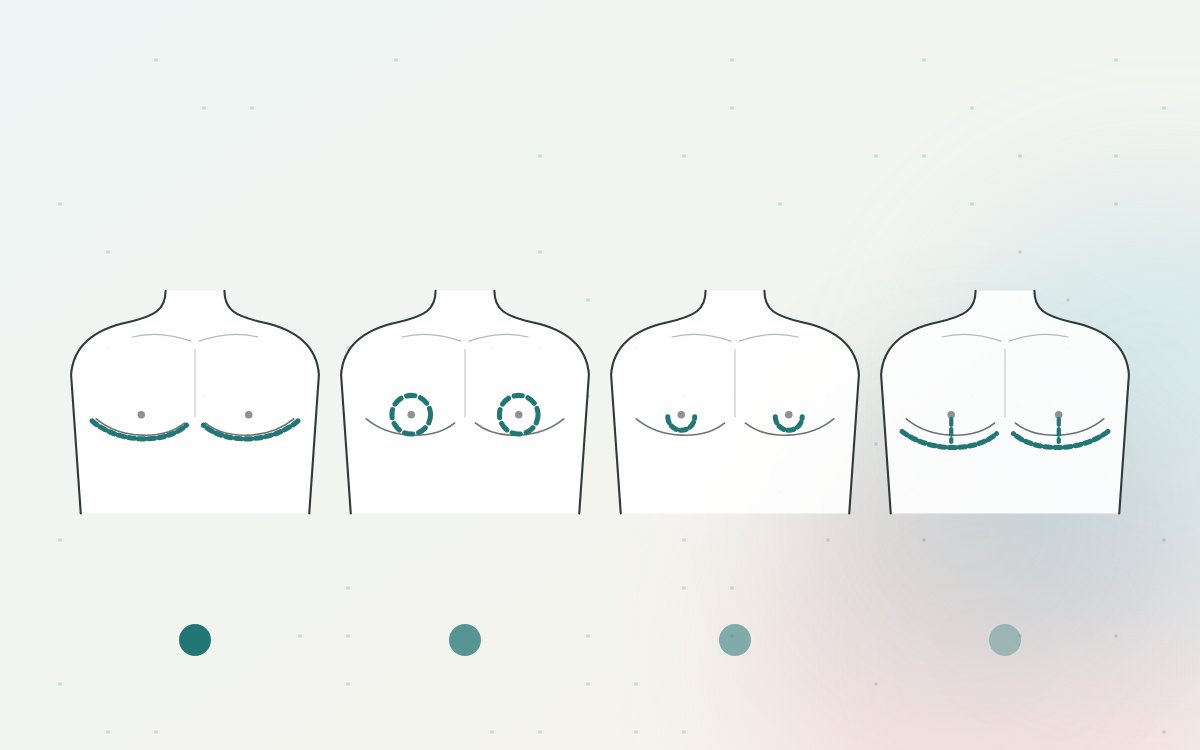
| Double incision | Medium to large volume, less elastic skin | Two horizontal incisions along the lower pectoral border | Usually free graft, resized and repositioned | Very predictable contour; nipple sensation often reduced; risk of partial graft loss |
| Periareolar | Small to moderate volume, elastic skin | Around the areola | Stays attached; areola can be reduced | Possible residual skin or puckering; revision more common if skin does not retract |
| Keyhole | Very small volume, very elastic skin | Small incision at the lower edge of the areola | Stays attached | Suitable for few candidates; no skin removal |
| Buttonhole / inverted T | Medium to large volume when keeping the nipple on a pedicle | Similar to double incision, sometimes with an additional vertical scar | Stays attached to a pedicle | May favour sensation; chest may look slightly less flat |
| Non-binary approaches | Variable, depending on goals | Depend on the underlying technique | Nipples can be reduced or omitted | Personalised goals: flat chest, reduction, neutral contour |
The table is a simplification: many surgeons combine or adapt top surgery techniques to the individual chest. The shape and length of your top surgery scars also depend on the technique chosen.
Personal goals: not everyone wants the same result
Beyond anatomy, your goals matter. Some people want a completely flat chest with a typically masculine look; others – many non-binary people in particular – prefer a reduction, a more neutral contour, smaller nipples or no nipples at all. Scar placement, being comfortable shirtless at the beach or the gym, and recovery time can also carry different weight for different people. Talk about this openly at your consultation: a good surgeon adapts the plan to your goals and explains honestly what is realistically achievable with your chest.
Some factors do not depend on the technique but still shape the result: a stable weight in the months before surgery (large changes afterwards can alter the contour), avoiding nicotine, and being ready to follow your recovery instructions carefully. If you expect to lose a lot of weight, it may make sense to discuss the best timing for surgery with your surgeon. For everything else, from requirements to costs, see our complete top surgery guide.
Risks common to all techniques
Every technique carries risks: haematoma, seroma (fluid collection), infection, delayed healing, partial or complete nipple graft loss, changes in sensation, asymmetry, contour irregularities (for example "dog ears" at the sides), scar problems and the possible need for a revision. Smoking significantly increases the risk of wound-healing complications.
Questions to ask your surgeon
- Which technique do you recommend for my chest, and why? What are the alternatives?
- Where will the scars be and roughly how long?
- How will the areola and nipple be handled (graft, pedicle, reduction)?
- What can I expect regarding sensation?
- Will you use drains? How long will I need to wear a compression vest?
- How often do you see revisions with this technique, and how are they handled?
- Can I see before-and-after photos of chests similar to mine?
If you would like a first opinion on your options, you can request a free top surgery consultation: your photos are reviewed by a partner surgeon before any decision is made.
Still deciding where to have surgery? Compare top surgery destinations in Europe and worldwide, for example top surgery in Turkey with surgeons experienced in all the main techniques.
Sources and further reading
- Schedule Gender-Affirming Surgery (Mastectomy – requirements) – Cleveland Clinic
- Top Surgery (Chest Feminization or Chest Masculinization) – Johns Hopkins Medicine
- Postoperative care and common issues after masculinizing chest surgery – UCSF Transgender Care
- Techniques for Preserving the Nipple Areolar Complex in Chest Masculinization for All Chest Sizes – Cureus (2025), PubMed Central
- Top Surgery – TransHub – ACON (NSW, Australia)
Last checked: 10/2026
Frequently asked questions
You can share your preferences and goals, but the technique is decided together with the surgeon based on chest volume, skin elasticity and nipple position. A technique that does not suit your chest increases the risk of revision.
Keyhole surgery removes no skin. It therefore only works for very small volumes and very elastic skin; otherwise excess skin would remain, causing folds and irregularities.
With free nipple grafts, sensation is usually reduced and may only partly return over time. The extent varies from person to person and cannot be predicted with certainty.
No. Any technique may need touch-ups, for example for asymmetry, residual skin or scars. Choosing a technique that suits your chest reduces this likelihood but does not eliminate it.
You can send chest photos for a preliminary assessment through our free consultation. A definitive opinion, however, is only possible after an in-person examination by the surgeon.
Note: the content on this website is for general information only and does not replace personal medical advice, diagnosis or treatment. Procedures are performed by independent surgeons and facilities. Results vary between individuals and cannot be guaranteed.
More guide articles

Top surgery requirements
Who can have top surgery? WPATH SOC8 criteria, age, informed consent, pre-op tests, smoking, BMI and the letters some clinics ask for – explained clearly.
Read more
Preparing for top surgery
Preparing for FTM top surgery: quitting nicotine, medications to discuss with your doctor, help at home, what to pack, travel planning and mental preparation.
Read moreLatest articles

06.10.2026
Top surgery requirements

02.10.2026
Preparing for top surgery

28.09.2026
Top surgery recovery

24.09.2026